
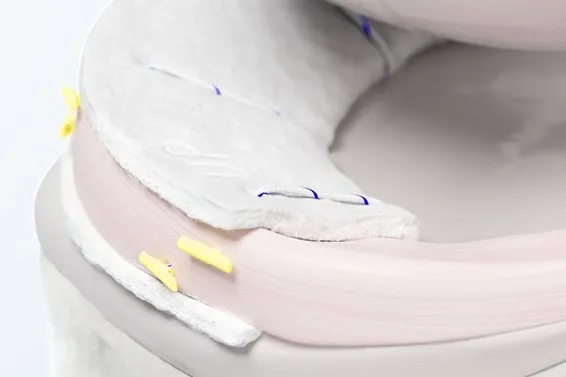

AMMR® Chondro-Gide®
AMMR® (Arthroscopic Matrix-Based Meniscus Repair) is an all-arthroscopic technique for biological meniscal tear repair using Chondro-Gide®, a bilayer collagen I/III membrane. There is agreement that meniscal lesions should, wherever possible, be treated by preserving as much meniscal tissue as possible, since partial or total meniscectomy leads to degenerative changes in the knee.
Patients who undergo meniscus resection at a relatively young age often suffer from early osteoarthritis and may subsequently require total joint replacement.
In the AMMR® technique, the damaged meniscus is wrapped with the Chondro-Gide® membrane. The smooth side of the bilayer collagen membrane faces the joint space, whilst the rough, porous side faces the meniscus surface. The meniscus is first stabilised using suture techniques, then the membrane is fixed around it and bone marrow aspirate is injected between the meniscus and the membrane. Alternatively, microfracture of the intercondylar notch can be performed to bring cells and growth factors to the stabilised tear site. The Chondro-Gide® membrane forms a protected biological chamber where additional biologic factors can support the healing process.
Background
The concept of arthroscopic meniscus wrapping was developed and first introduced in 2003 by Prof. Roland P. Jakob at Kantonsspital Fribourg, Switzerland, and published in 2010 with the technique and first results. After a follow-up of 2.5 years, 90% of the 30 patients included maintained their treated menisci. The authors concluded that the technique appeared to improve the chances of healing but that it was technically demanding. Tomasz Piontek (Poznań, Poland) invested further work in this technique, which was named Arthroscopic Matrix-Based Meniscus Repair — AMMR®.
Clinical Evidence
5-Year Results
The 5-year results of the AMMR® technique were assessed in a study of 39 patients, assigned to two groups: those with isolated meniscal repair and those with meniscal repair combined with simultaneous ACL reconstruction. The AMMR® treatment showed good mid-term clinical and MRI-based outcomes for complex meniscal tears, as well as a favourable survival rate.
10-Year Results
In 2023, the 10-year outcomes of the same cohort were published. For the 10-year follow-up, 23 patients were available. Significant improvements in IKDC and Lysholm subjective scores were demonstrated compared to pre-operative baseline scores. The mean IKDC score at 10 years was 88.81 and the mean Lysholm score was 92.22. The improvement was sustained over the entire 10-year follow-up period and, based on MRI evaluation (WORMS), no further degenerative changes were observed within the 10 years. Tear type and combination with ACL reconstruction had no influence on clinical outcome.
Alternative Insertion Technique
As an alternative to the clamp-based technique, there is also the possibility of matrix insertion by sliding the membrane down sutures during arthroscopic matrix-based meniscus repair. This technique was described in 2025 by Ho et al. and is a modification of the parachute technique originally described by Piontek et al. in 2012, making use of pre-deployed sutures from the primary fixation of the meniscal tear.
- Videos
- SKUs
- Brochures
- Clinical Studies